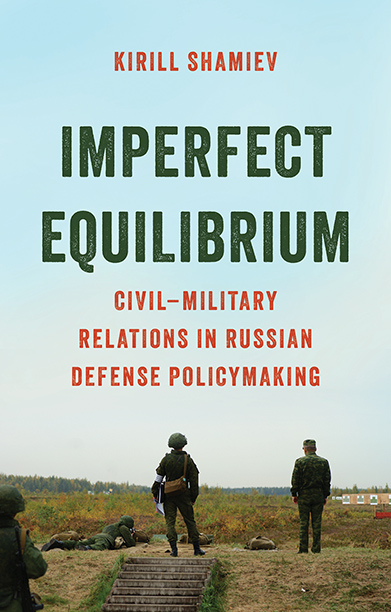
Why has Russia’s military struggled to adapt to the challenges of contemporary warfare?
This book explains the political reasons behind Russia’s poor attempts to reform its armed forces before the war in Ukraine. Drawing on extensive qualitative and quantitative evidence—including interviews, parliamentary speeches, media reports and surveys—it shows how unchecked autonomy can undermine military development, even in authoritarian contexts. It is published by Hurst Publishers (Europe) and Oxford University Press (North America).
Hurst, February 2026 · Oxford University Press, July 2026 · 280 pages
Reviews
As Clausewitz developed his theory of war preparations and war proper, Shamiev’s contemporary analysis of bureaucratic and institutional perspectives on defense policymaking clearly parallels Clausewitzian theory by his conceptualization of the interaction among presidential, military, and civilian coalitions involved in military-institutional decision-making.
Matteo Mazziotti di Celso, Institut de recherche stratégique de l’École militaire (IRSEM), in Armed Forces & Society (2026)
In this comprehensive study, Shamiev, a political scientist, explores cycles of defense reform in post-Soviet Russia by examining the interaction of presidential authority, military leadership, and civilian oversight.
Maria Lipman, in Foreign Affairs
Endorsements
A deeply insightful and illuminating account, shedding light on the important role civilian–military relations played in shaping defense reform and policymaking in Russia, from the end of the Cold War to the Russian invasion of Ukraine.
Michael Kofman, Senior Fellow, Russia and Eurasia Program, Carnegie Endowment for International Peace
Every army reflects the society from which it is drawn; Russia is no exception. Imperfect Equilibrium explains how conservatism, competing strategic visions, and bureaucratic infighting left Putin’s army ill-prepared for his war in Ukraine and will continue to hinder military reform.
John Foreman, UK Defence Attaché in Moscow (2019–22) and Kyiv (2008–11)
This comprehensive analysis focuses on the ideas, interests and identities of key actors and their impact on the performance of the Russian armed forces. A must-read for scholars of Russia.
Vladimir Gel’man, Professor of Russian and Eurasian Politics, University of Helsinki
Shamiev insightfully connects complex Kremlin politics to its influence on military development. This fascinating, well-researched book is a welcome addition to the field of military analysis.
Dara Massicot, Senior Fellow, Russia and Eurasia Program, Carnegie Endowment for International Peace
A thoughtful and deeply researched account of civil–military relations in the post-Soviet period.
Mikhail Kasyanov, former prime minister of Russia
