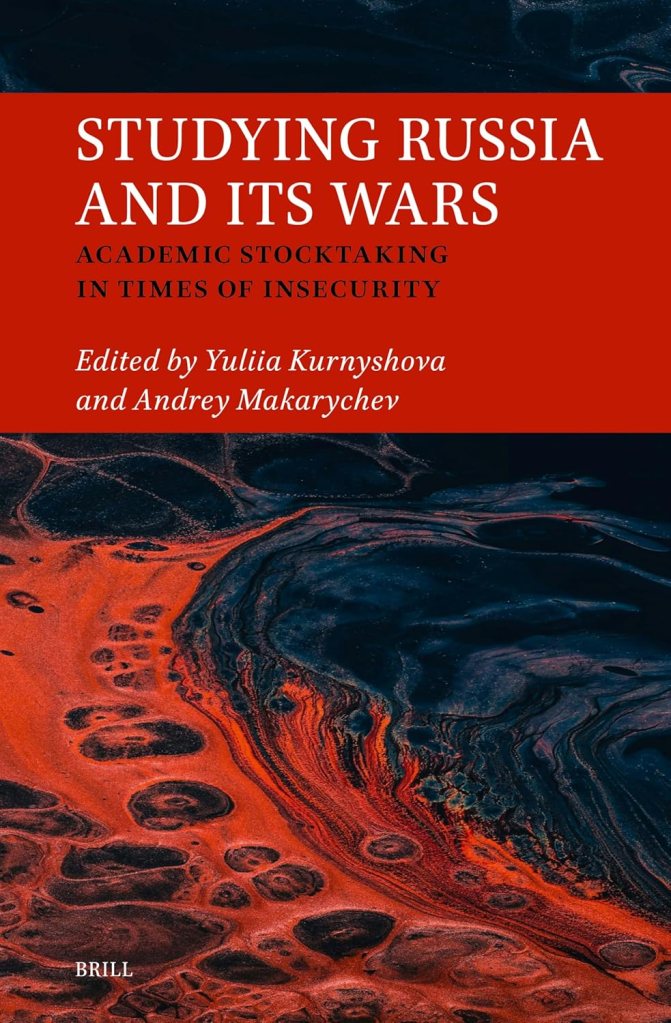
Shamiev, K. (2025). Chapter 10, Chekhov’s Gun: Security Services and Blind Spot of Russia Studies, In Studying Russia and its Wars: Academic Stocktaking in Times of Insecurity (pp. 191-217). Brill.
Book description: Russia’s invasion of Ukraine took by surprise not only politicians in many countries, but also experts who, for many years after the end of the Cold War, were confident of the growing mutual interdependence between Russian and European economies, and in the changing function of borders – from dividing to connecting. Most scholars have not only overlooked the aggressive potential inherent in the seemingly innocent calls for multipolarity carried out by the Russian leadership. This book discusses how the current war in Ukraine makes the scholarly community reconsider previous assumptions of Russia’s domestic regime and security policies, and think of novel approaches to study the Russia-produced insecurities. This edited volume calls for a scholarly audit of the academic legacy that has prevented most researchers and public intellectuals from not only predicting, but also considering as a serious possibility the full-scale war that Russia unleashed against Ukraine.
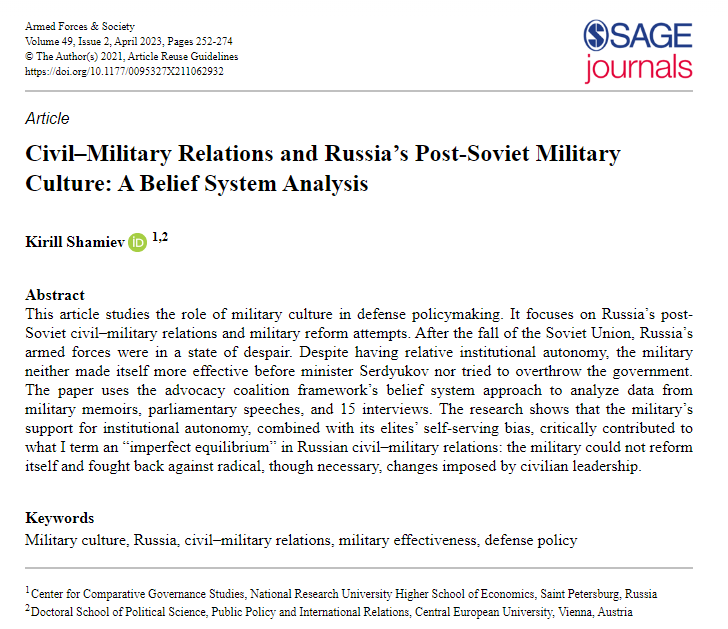
Shamiev, K. (2023). Civil–Military Relations and Russia’s Post-Soviet Military Culture: A Belief System Analysis. Armed Forces & Society, 49(2), 252-274.
Abstract: This article studies the role of military culture in defense policymaking. It focuses on Russia’s post-Soviet civil–military relations and military reform attempts. After the fall of the Soviet Union, Russia’s armed forces were in a state of despair. Despite having relative institutional autonomy, the military neither made itself more effective before minister Serdyukov nor tried to overthrow the government. The paper uses the advocacy coalition framework’s belief system approach to analyze data from military memoirs, parliamentary speeches, and 15 interviews. The research shows that the military’s support for institutional autonomy, combined with its elites’ self-serving bias, critically contributed to what I term an “imperfect equilibrium” in Russian civil–military relations: the military could not reform itself and fought back against radical, though necessary, changes imposed by civilian leadership.
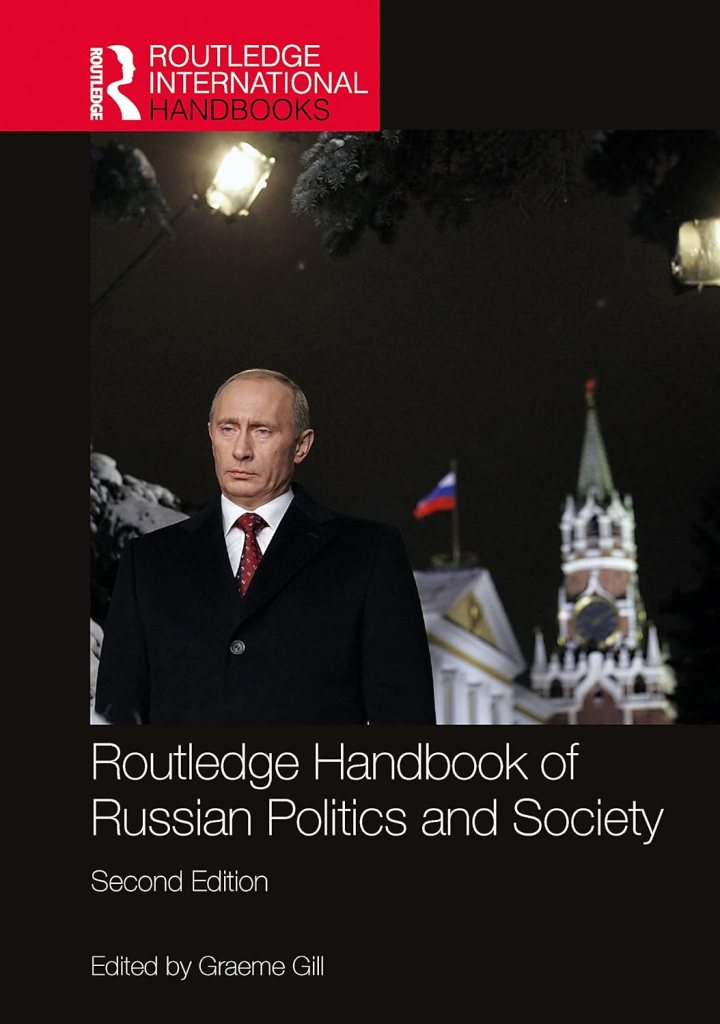
Shamiev, K., & Renz, B. (2022). The security services. In Routledge Handbook of Russian Politics and Society (pp. 227-238). Routledge.
Abstract: The role and influence of the Russian security services has been a widely discussed issue since the election of Vladimir Putin as president in 2000. In accordance with Russian law in the sphere of security and defence, a number of bodies of executive power have under their command uniformed personnel and are allowed to maintain and command militarised formations. The exact composition of the Russian security apparatus remains contested and different characterisations have been offered by a number of analysts. The Federal Security Service is the major institutional successor of the Soviet KGB and the largest and most prominent of the Russian security services. The Russian Interior Ministry, or MVD, is the institutional successor of the Soviet MVD. The Federal National Guard Service is the youngest addition to Russia’s security apparatus, having been created in April 2016. The Ministry of Defence is the largest component of Russia’s security sector.
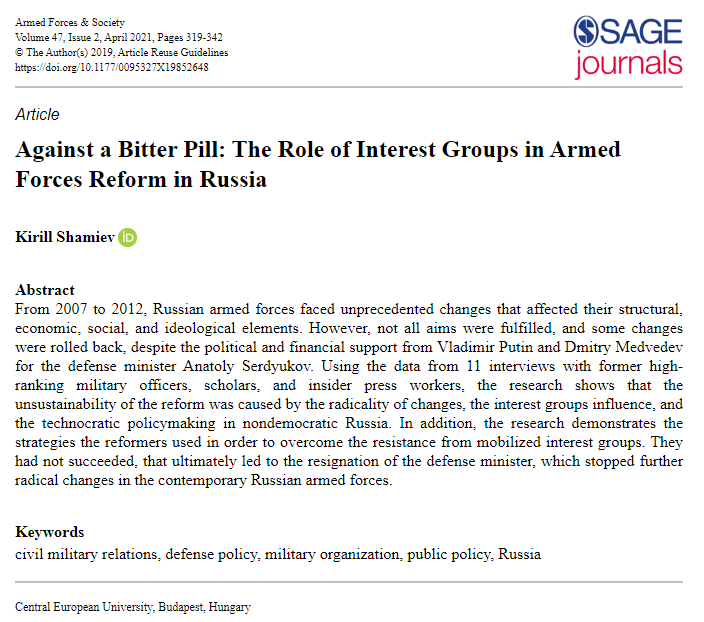
Shamiev, K. (2021). Against a Bitter Pill: The Role of Interest Groups in Armed Forces Reform in Russia. Armed Forces & Society, 47(2), 319-342.
Abstract: From 2007 to 2012, Russian armed forces faced unprecedented changes that affected their structural, economic, social, and ideological elements. However, not all aims were fulfilled, and some changes were rolled back, despite the political and financial support from Vladimir Putin and Dmitry Medvedev for the defense minister Anatoly Serdyukov. Using the data from 11 interviews with former high-ranking military officers, scholars, and insider press workers, the research shows that the unsustainability of the reform was caused by the radicality of changes, the interest groups influence, and the technocratic policymaking in nondemocratic Russia. In addition, the research demonstrates the strategies the reformers used in order to overcome the resistance from mobilized interest groups. They had not succeeded, that ultimately led to the resignation of the defense minister, which stopped further radical changes in the contemporary Russian armed forces.
In Russian:
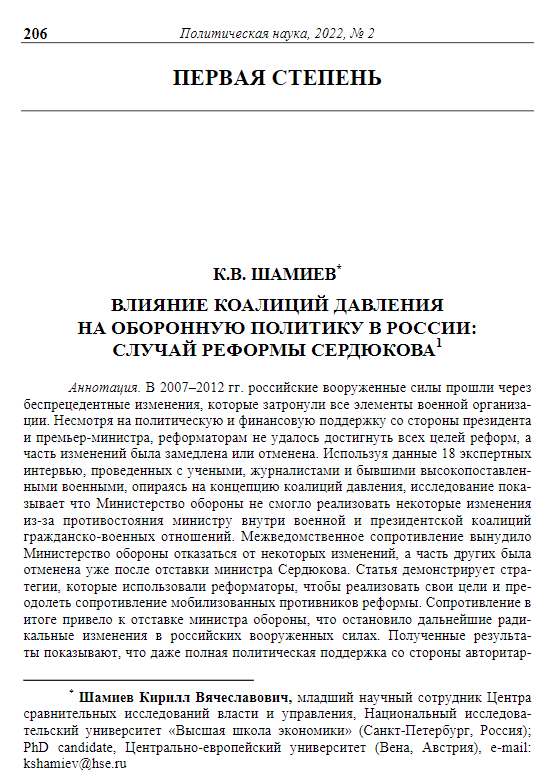
Шамиев, К. В. (2022). Влияние коалиций давления на оборонную политику в России: случай реформы Сердюкова. Политическая наука, (2), 206-229.
Abstract: В 2007-2012 гг. российские вооруженные силы прошли через беспрецедентные изменения, которые затронули все элементы военной организации. Несмотря на политическую и финансовую поддержку со стороны президента и премьер-министра, реформаторам не удалось достигнуть всех целей реформ, а часть изменений была замедлена или отменена. Используя данные 18 экспертных интервью, проведенных с учеными, журналистами и бывшими высокопоставленными военными, опираясь на концепцию коалиций давления, исследование показывает что Министерство обороны не смогло реализовать некоторые изменения из-за противостояния министру внутри военной и президентской коалиций гражданско-военных отношений. Межведомственное сопротивление вынудило Министерство обороны отказаться от некоторых изменений, а часть других была отменена уже после отставки министра Сердюкова. Статья демонстрирует стратегии, которые использовали реформаторы, чтобы реализовать свои цели и преодолеть сопротивление мобилизованных противников реформы. Сопротивление в итоге привело к отставке министра обороны, что остановило дальнейшие радикальные изменения в российских вооруженных силах. Полученные результаты показывают, что даже полная политическая поддержка со стороны авторитарного лидера не может спасти политиков и их программы от влияния других акторов. Недовольство изменениями вызывает раскол в президентской коалиции и ослабляет межведомственное взаимодействие, что ослабляет управленческие позиции реформатора. Более того, изучаемый случай показал, что в гражданско-военных отношениях большую роль играет не только фактическая составляющая реформы, но и соответствие поведения реформатора доминирующим убеждениям военнослужащих.
 Kirill Shamiev